














Author

Cloud strategy is about making accountable, future‑proof decisions—not just choosing platforms. It reflects how confidently organisations can stand behind their technology choices today, while remaining resilient to tomorrow’s change.
In South Africa, organisations are increasingly balancing innovation with control, adopting more sophisticated multi‑model cloud approaches to manage risk, meet regulatory demands, and build long‑term operational resilience.

Cloud has become central to how South African organisations operate
Cloud has become foundational to how South African organisations operate and make strategic decisions. This reflects the fact that cloud adoption in South Africa has reached mainstream maturity, with over 80% of enterprises already relying on cloud services and 88% planning to increase their cloud budget in 2026. Rather than signalling early-stage adoption, this marks a shift to cloud as an established organisation-wide capability. The drivers are clear:
- Digital transformation and the need for scalable, resilient infrastructure.
- AI and analytics workloads that demand elastic compute and modern data platforms.
- Business continuity concerns, amplified by energy constraints and infrastructure challenges unique to the South African context.
- Regulatory momentum, with government investing $600m (~R9880m) in digital infrastructure and actively promoting hybrid cloud and AI adoption.
However, widespread adoption does not automatically equate to maturity—and that distinction is becoming increasingly clear.
Cloud maturity is now fundamentally a leadership, governance, and talent issue
South African organisations have largely completed the cloud adoption phase. The next phase—optimisation, AI enablement, and value realisation—will be what truly differentiates those that achieve sustained impact and long‑term advantage.
Success will depend less on technology choices and more on governance, skills, investment discipline, and executive alignment.
What cloud-related initiatives have been implemented across many parts of the organisation?
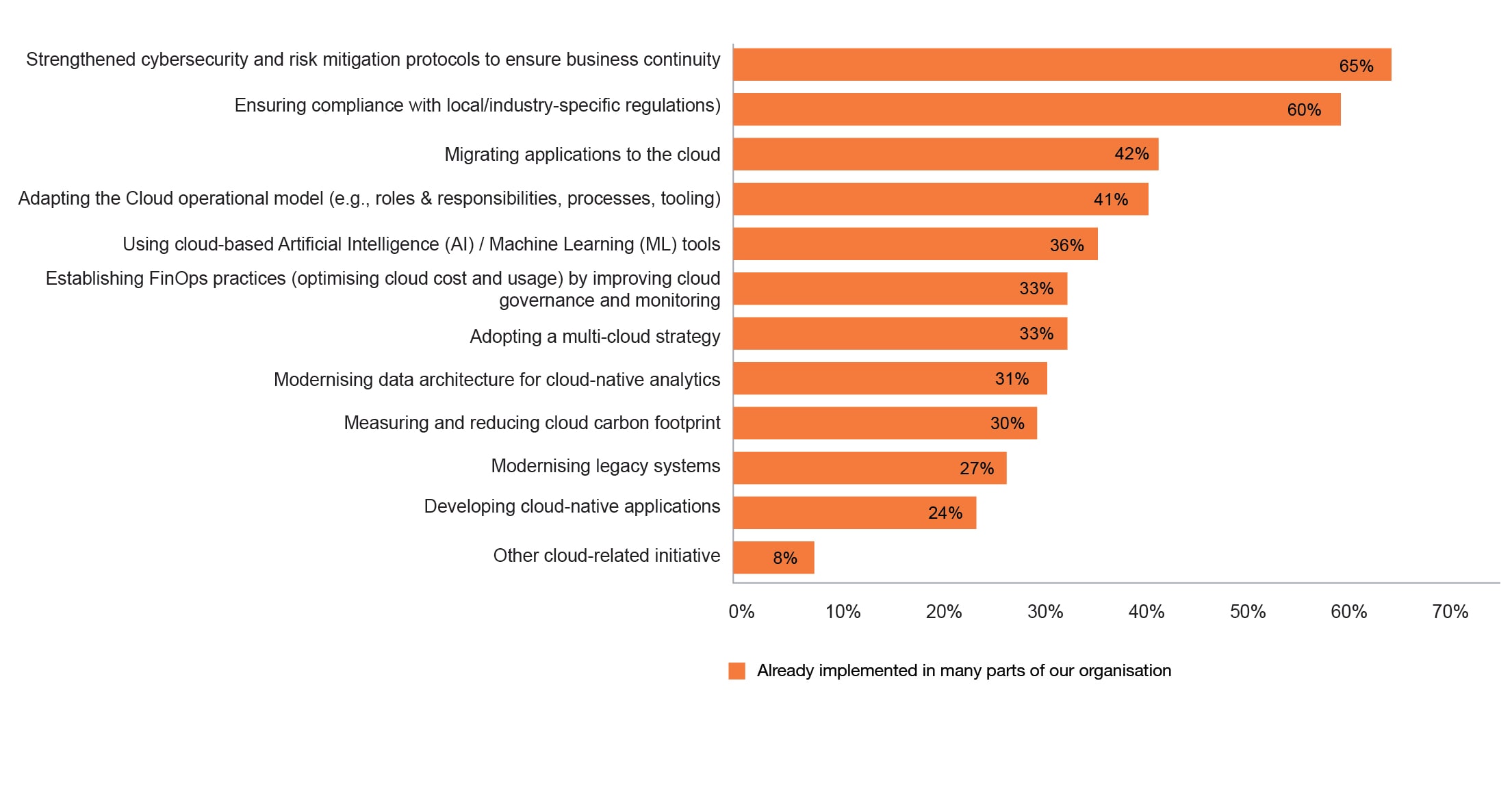
South Africa's barriers are real but not insurmountable. Budget constraints (44%) and data privacy security concerns (55%) top the list, but organisations are already actively addressing cyber risks and regulatory compliance. The most critical gap? Governance and FinOps discipline—the connective tissue that turns cloud spending into cloud value. Leaders who close these gaps will move from managing risk to capturing opportunity.
Sovereignty and trust are now central to cloud infrastructure decisions
The days of a single-cloud strategy are over. South African organisations are embracing hybrid and multi-cloud architectures—86% now run workloads across multiple providers to enhance resilience, avoid vendor lock-in, and meet regulatory requirements.
This reflects a fundamental shift in decision‑making. Cloud choices are increasingly shaped by where data resides, who governs it, and how defensible those decisions are to regulators, customers, and Boards—not simply by cost or functionality.
Across all cloud models, the strongest drivers of changing infrastructure are no longer purely technical or commercial.
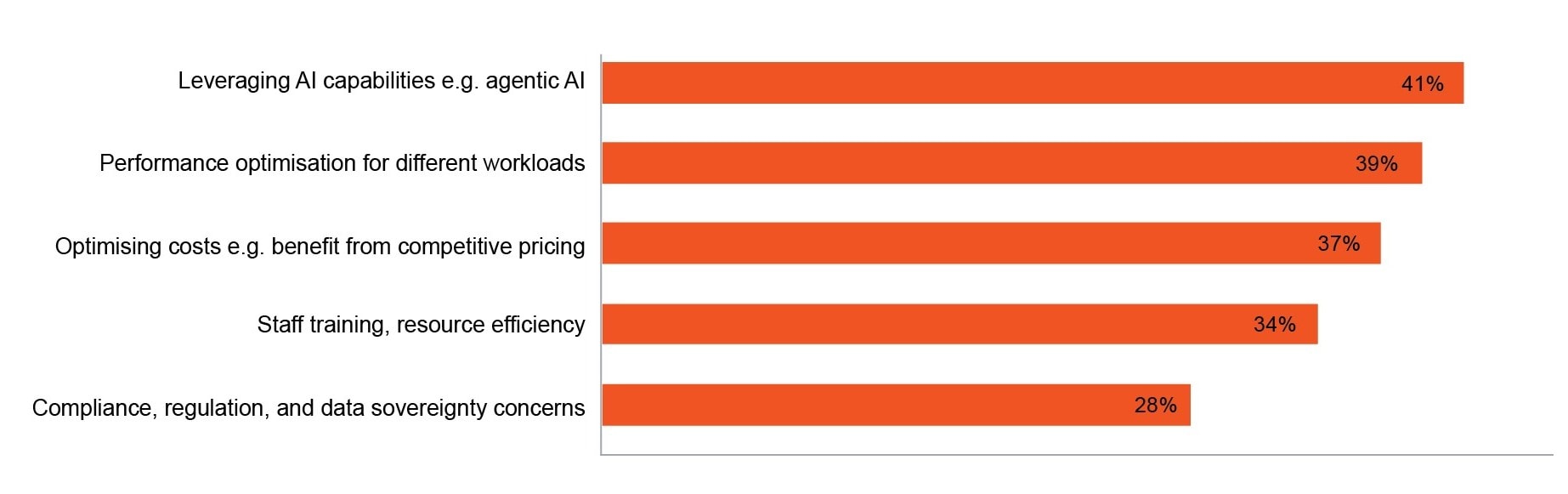
What are the reasons organisations are changing cloud infrastructure?
What Sovereign cloud means
Sovereign cloud is about ensuring cloud services operate in line with national regulations and organisational control requirements, specifically governing where data is stored, how it is managed, and who can access it. It enables organisations to balance sovereignty, flexibility, and innovation rather than treating compliance as a standalone constraint.
While private cloud can offer strong control, it often limits access to hyperscalers’ scale, innovation, and economies of scale. Sovereign public cloud aims to bridge this gap by combining local compliance and control with the innovation power of global platforms.
The main cloud models now central to enterprise strategies:
- Public cloud providers offer global scale and services (e.g. Microsoft Azure, AWS, Google Cloud, Oracle).
- Sovereign public clouds adapt hyperscale offerings aligned to local regulatory requirements.
- Trusted or national clouds are locally owned and operated for national-interest data.
- Private clouds deliver maximum control but lower scalability.
- Managed Service Providers operate and optimise cloud environments tailored to customer needs.
Different cloud models serve different trust needs
The data makes clear that organisations are not converging on a single “best” cloud model. Instead, they are matching workloads to trust requirements:
- Sovereign public cloud is favoured for scale, innovation, and AI capability (42%).
- National partners (trusted) cloud is used where risk mitigation (39%), or workload sensitivity is paramount (37%).
This portfolio approach reflects a growing maturity in cloud strategy—one that recognises trust is contextual, not universal.
A more resilient model for the future
Sovereignty and trust are practical design principles shaping cloud architectures and operating models. The organisations that succeed will be those that treat cloud not just as a platform for innovation, but as a foundation for trust, regulatory confidence, and resilience—with deliberate choices about control, data, and dependency built in from the start.
South Africa's cloud architecture is becoming increasingly sophisticated and deliberately diversified. Sovereign public cloud is the vehicle for AI innovation, while trusted/national cloud solutions anchor resilience and risk management. A blended, multi-cloud approach—with sovereignty woven into the fabric—is the winning strategy. Organisations that codify sovereignty into their architecture, governance, and procurement will unlock trusted AI at scale and build durable competitive advantage.